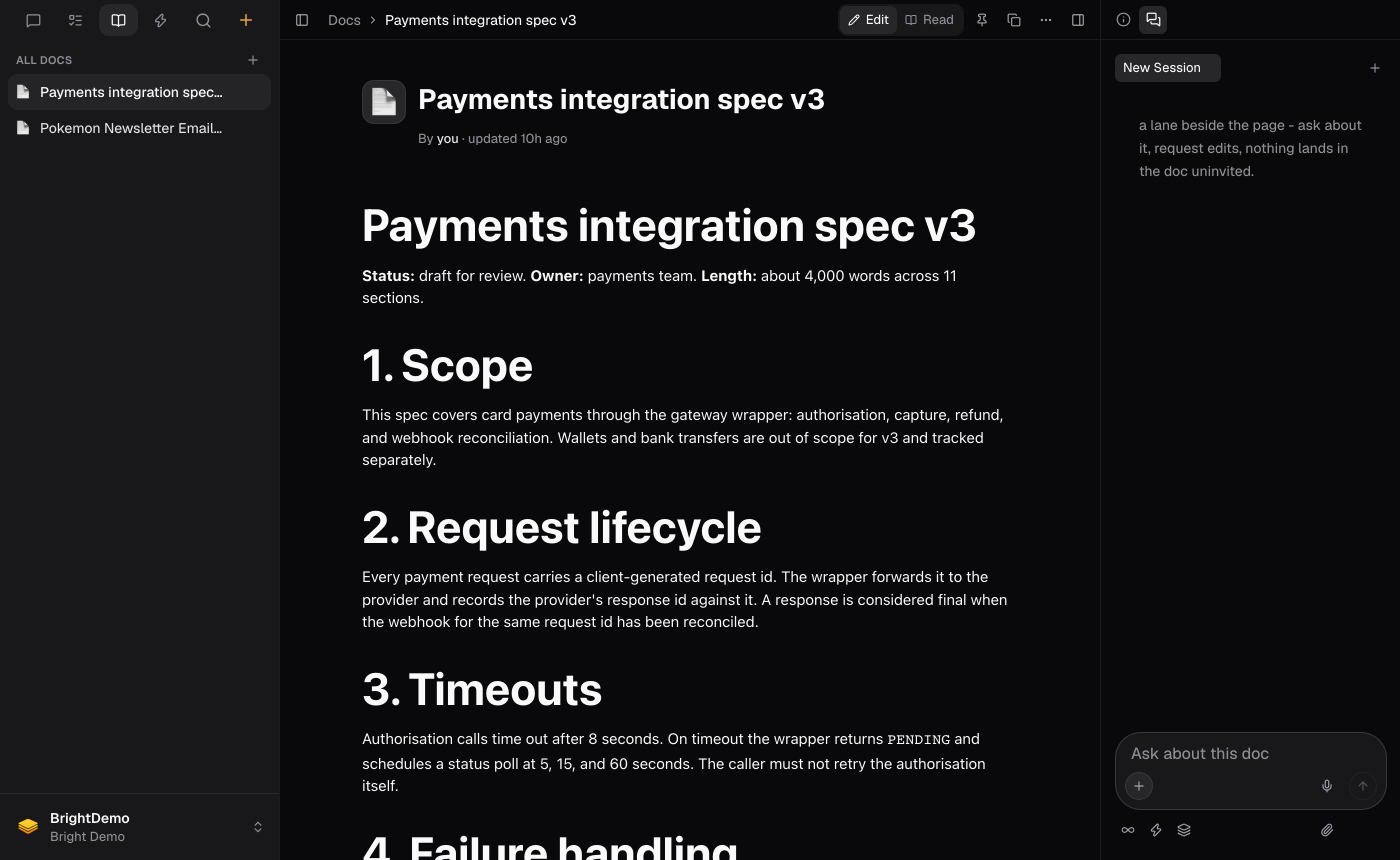
1. Use the document’s own chat, not a new session
Open the document and use the context chat beside it. The distinction matters: a session is a conversation that happens to mention a document, while the document’s context chat is anchored to the text in front of you. The document stays on screen, so every claim the agent makes can be checked against the paragraph it came from. Start a New Session (the + button in the Side Sessions strip) when the thread you are in has served its purpose. A gap analysis and a rewrite do not need to share a thread.2. Ask questions that have a wrong answer
“Summarize this” produces something fluent that you cannot check. Ask for things the document either contains or does not:Ask for quotes and the answer becomes checkable. A claim with a quoted line can be verified in seconds against the text on screen. A claim without one cannot be distinguished from something the agent recalled about the domain in general.
3. Keep the agent anchored to the text
The failure mode with a long document is drift: the agent begins answering from general knowledge and stops reading. A drifted answer reads exactly as confident as a grounded one. Two habits prevent it. Add “base your answer only on this document; if it is not stated here, say so” to questions of substance. And when an answer sounds like received wisdom rather than a reading of this text, ask “which section of this document supports that?” A drifted answer cannot produce the section.4. Turn findings into work without leaving the page
When the gap analysis lands on something real (the spec never mentions idempotency keys on retry), that is an issue, not a note. Ask the agent to create it. Give it the same care you would give a hand-written issue: the problem, the evidence quoted from the spec, and the open question. Two things to expect. The write pauses for a tool approval, which is the checkpoint working; read the card and allow it once. And the resulting issue is the record: it appears in the Plan issue views and follows the issue workflow. A long chat answer, however good, registers nothing.5. Edit in place, and know what cannot be undone
The document is a block editor. Typing/ on an empty line gives headings, lists, check lists, code blocks with syntax highlighting, tables, and image, video, audio, and file blocks. Restructure the spec as you go: pull the failure cases into a table, add a check list of the gaps.
Docs keeps no version history and offers no restore. Deleting a parent deletes every document nested inside it. Before an edit you are unsure about, duplicate the document first; that is the only undo here.
6. Leave the document better than the conversation
The chat scrolls away. Whatever the analysis produced, the gap list, the decision, the open questions, belongs in the document itself or in a linked issue. A document with a resolved question and no record of how it was resolved sends the next reader down the same forty minutes.What good looks like
- Every substantive claim came with a quoted line you could check.
- Gaps became issues with the evidence quoted, not just noted in chat.
- The document itself changed; the analysis is not stranded in a thread.
- You duplicated before any edit you were unsure about.
Good to know
- The document’s context chat is anchored to the text on screen. A session only mentions the document.
- New Session (the + button in the Side Sessions strip) starts a fresh thread beside the same document.
- Creating an issue from the chat pauses for a tool approval. Read the card and allow it once.
- The created issue appears in the Plan issue views and follows the issue workflow. A chat answer registers nothing.
/on an empty line opens the block menu: headings, lists, check lists, code blocks, tables, and image, video, audio, and file blocks.- Docs keeps no version history and offers no restore. Deleting a parent deletes every nested document. Duplicate first; that is the only undo.